Okay so here’s the deal with Seller Central versus KDP because I literally just walked someone through this yesterday and they were SO confused about which one to use.
The Basic Difference Nobody Explains Right
KDP is Kindle Direct Publishing. That’s where you publish books—ebooks, paperbacks, hardcovers. It’s Amazon’s publishing platform. You upload your manuscript, set your price, and boom you’re an author.
Seller Central is where you sell physical products on Amazon. Like if you’re dropshipping phone cases or selling your own brand of whatever. But here’s where it gets messy… you CAN also sell books through Seller Central if you already have printed books from somewhere else.
Most people asking this question should just use KDP. Like 95% of you reading this, KDP is your answer. But let me break down when you’d actually need Seller Central because there ARE legit reasons.
When You Actually Need KDP (Most People)
If you’re writing a book or creating low-content books (journals, planners, coloring books, that stuff), you want KDP. Period. I’ve published like 200+ books through KDP and it’s honestly the easiest money I’ve made online once you figure out the system.
KDP handles everything:
- Printing on demand (they print when someone orders)
- Shipping to customers
- Customer service for the most part
- Returns and refunds
- Getting your book on Amazon’s main catalog
You get paid royalties. For paperbacks it’s usually 60% of your list price minus printing costs. For ebooks it’s either 35% or 70% depending on your price and which territories you select. The 70% option has some restrictions but most people qualify.
Oh and another thing—KDP books automatically get an ISBN if you don’t have one. Amazon assigns a free ISBN which is huge because buying your own ISBNs is like $125 each or something ridiculous. Though if you want your own publishing imprint name to show up, you gotta buy your own ISBN from Bowker. I did that for maybe 10 books before I realized nobody actually cares and the free Amazon ISBN works fine.
The Seller Central Situation
Seller Central is for when you’ve already got physical books printed elsewhere and you wanna sell them on Amazon. Maybe you did a big print run with IngramSpark or some local printer, and now you’re sitting on 500 copies in your garage.
Here’s what people don’t tell you: Seller Central costs money upfront. You need a Professional selling account which is $39.99/month. There’s also an Individual account that’s free monthly but charges $0.99 per item sold, which adds up FAST if you’re actually selling books.
With Seller Central you’re shipping books yourself (or using FBA which I’ll get to) and you’re handling inventory. You’re not getting royalties—you’re making whatever profit margin you set between your cost and list price.
Why Would Anyone Use Seller Central Then
Good question. Here’s the actual use cases I’ve seen work:
Bulk printing for higher margins: If you’re selling a TON of copies, sometimes printing 1000 books at once with a commercial printer gets your per-unit cost way lower than KDP’s print-on-demand. Like maybe $2 per book instead of $4. If you’re selling at $19.99, that extra $2 per copy adds up.
Special formats KDP doesn’t support: Want a spiral bound book? Weird trim size? Special paper? KDP has limitations. Seller Central lets you sell whatever you’ve printed elsewhere.
You’re already selling other products: If you’ve got a Seller Central account for your other business, adding books to your catalog might make sense. You’re already paying that monthly fee anyway.
International situations: Sometimes if you’re outside the US and have specific distribution needs… actually this gets complicated and I’m not gonna pretend I’m an expert on international stuff.
The FBA Angle That Confuses Everyone
Wait I forgot to mention—if you use Seller Central, you can do FBA (Fulfilled by Amazon). You ship your books to Amazon’s warehouse, they store them and ship to customers. It’s like… kinda similar to KDP’s model but you’re paying storage fees and fulfillment fees.
My friend tried this last year with a cookbook she’d printed 2000 copies of. She sent them all to FBA and it worked pretty well actually? But the storage fees during Q4 almost killed her because Amazon charges MORE to store stuff during holiday season. She was paying like $600/month just for storage at one point because her books weren’t moving fast enough.
This is gonna sound weird but I was watching this documentary about warehouses the other night and it made me think about how insane Amazon’s logistics are. Like they’ve got this whole system figured out. Anyway.
The Actual Money Breakdown
Let’s do real numbers because that’s what matters right?
KDP paperback example: You publish a 200-page paperback, list it at $12.99. Printing cost is about $3.65 for that page count. Amazon takes 40% of list price which is $5.20. You make $12.99 – $3.65 – $5.20 = $4.14 per sale. Not bad. No upfront costs, no inventory risk.
Seller Central example: You print 500 copies at $2.50 each (total $1,250 upfront). List at $12.99. If you do FBA, Amazon takes about $4.25 in fees per sale plus storage. You make roughly $12.99 – $2.50 – $4.25 = $6.24 per sale. Better margin BUT you paid $1,250 upfront plus $39.99/month for the account plus storage fees.
You’d need to sell like 250+ copies just to break even with the Seller Central approach. For most people that’s not happening fast enough.
What About Having Both
Yeah you can use both for the same book technically. Some people do KDP for most sales and then also list on Seller Central with special editions or signed copies. I tried this once and it was honestly more hassle than it was worth for me but I know authors who make it work.
The thing is you gotta be careful about competing with yourself. If your KDP version and Seller Central version are basically identical, customers will just buy the cheaper one and Amazon might get annoyed about duplicate listings.

The Part About Content Books vs Real Books
Okay so this matters—if you’re doing low-content or no-content books (journals, notebooks, planners, logbooks, all that stuff I’ve been making money with for years), you ONLY want KDP. Like don’t even think about Seller Central.
The margins on low-content work perfectly with KDP’s model because:
- You’re not writing anything substantial so you can pump out designs fast
- Customers don’t care about special printing or formats really
- You want to test lots of niches without inventory risk
- Print-on-demand means you can have 100 books live with zero upfront cost
I’ve got probably 150 low-content books just sitting there making passive income. Some sell 1 copy a month, some sell 50. It averages out to a nice chunk of change. Could NOT do that with Seller Central because I’d need to predict which ones would sell and pre-print inventory.
The Technical Setup Stuff
KDP setup is stupid easy. You need:
- An Amazon account (duh)
- Tax information (W-9 if you’re in the US)
- Bank account for deposits
- Your book files (manuscript PDF and cover)
Takes like 20 minutes to get your first book live. I remember my first one took me three hours because I kept messing up the cover dimensions but now I can upload a new book in literally 10 minutes.
Seller Central is more involved:
- Business verification (they want to know you’re legit)
- Sometimes they ask for bills or bank statements to verify your address
- UPC codes for your products (books need ISBNs which convert to UPCs)
- Way more settings and options to configure
The Seller Central dashboard is overwhelming honestly. Like there’s SO many menus and options. KDP’s dashboard is clean and simple—you see your books, your sales, your royalties. Done.
Customer Service Headaches
With KDP, Amazon handles almost all customer service. Someone has an issue with their book? Amazon deals with it. You might get an email notification but you usually don’t have to do anything.
With Seller Central, YOU are the seller of record. Customers can message you directly. You gotta respond within 24 hours or your account health score drops. If you’re doing FBA it’s a bit better because Amazon handles some of it but you’re still more involved.
My cat just knocked over my coffee while I’m typing this, hold on… okay back. Where was I?
The Returns Thing
Oh right so returns. KDP books can be returned and you lose that royalty. It happens but not that often in my experience. Maybe 2-3% of sales get returned.
Seller Central returns are more complicated. If you’re doing FBA, Amazon’s regular return policy applies—customers can return basically anything within 30 days. If you’re fulfilling yourself, you set your own return policy but Amazon heavily encourages being generous about it.
Which One For Your Situation
Let me just lay this out straight:
Use KDP if: You’re writing books, creating low-content books, want passive income, don’t wanna deal with inventory, don’t wanna pay monthly fees, just wanna publish and let Amazon handle everything.
That’s like 90% of people asking this question.
Consider Seller Central if: You’ve already got thousands of books printed, you need special formats KDP doesn’t offer, you’re making high volume sales and the math works out on bulk printing, you already have a Seller Central account for other products.
Honestly unless you’ve got a specific reason you NEED Seller Central, just stick with KDP. I’ve been doing this since 2017 and I’ve made way more money with way less headache through KDP than the few times I’ve messed with Seller Central for books.
The Hybrid Publishers Warning
Quick tangent—some hybrid publishers will tell you they’ll “get your book on Amazon” and they use Seller Central to do it. They’re basically acting as a seller on your behalf. This is often a red flag because you could just do KDP yourself for free. They’re charging you for something you don’t need them for.
If a publisher mentions Seller Central in their pitch, ask why they’re not using KDP. There might be a legit reason but usually it’s because they want to maintain control over your listing and pricing.
Advertising Differences
Oh and another thing—Amazon Ads work differently. With KDP you run Amazon Ads through the KDP dashboard (or Amazon Advertising console). It’s set up for book marketing with keywords and sponsored product ads.
With Seller Central you’re using the same ad platform but competing more directly with other products. The ad costs and strategy are different. Book ads on KDP are usually cheaper per click because you’re in a more specific ecosystem.
I spend like $500-1000/month on Amazon Ads for my KDP books and it’s profitable. Tried advertising a Seller Central book once and the CPC was way higher, didn’t work out great.
Look, bottom line is this: start with KDP unless you’ve got a really specific reason not to. You can always expand to Seller Central later if your book takes off and you wanna explore bulk printing or special editions. But for getting started and making your first sales? KDP all the way. It’s what I used to build up to consistent $5k-30k months from publishing, and I’m still mostly using KDP for new releases because the model just works.

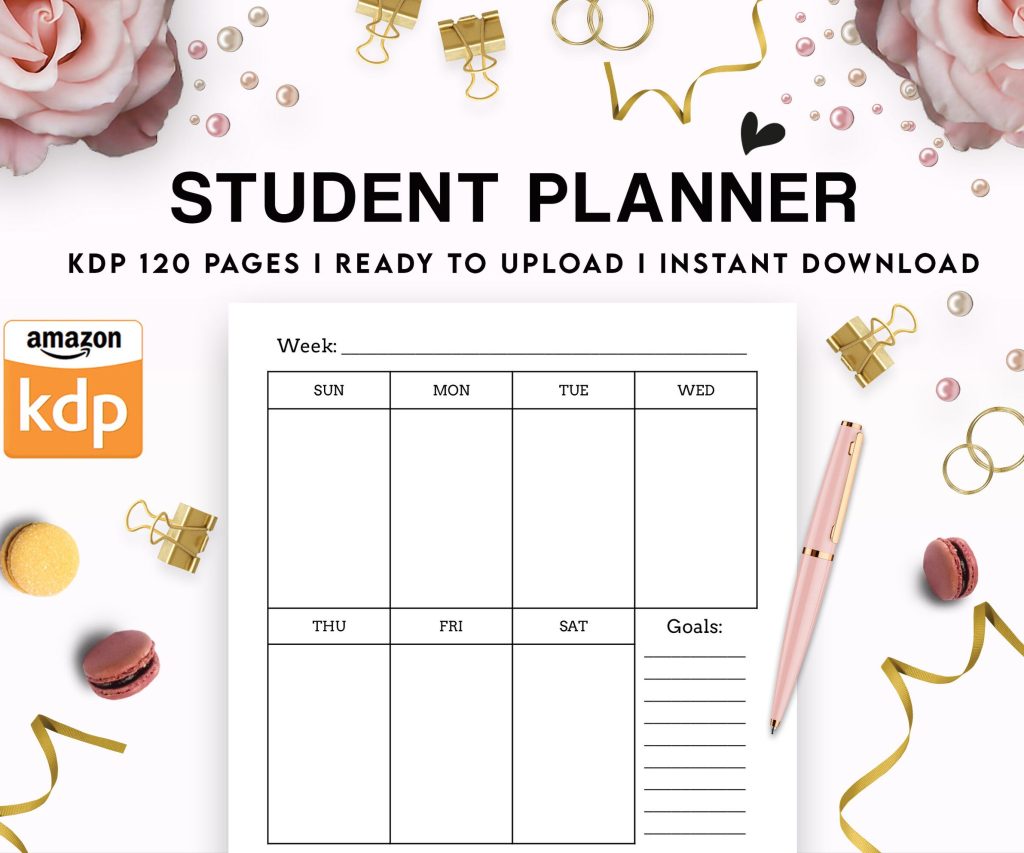 Student Planner Journal 120 pages Ready to Upload PDF Commercial Use KDP Template 6x9" 8.5x11" for Low Content book
1 × $0.00
Student Planner Journal 120 pages Ready to Upload PDF Commercial Use KDP Template 6x9" 8.5x11" for Low Content book
1 × $0.00  Wolf Coloring KDP interior For Adults, Used as Low Content Book, PDF Template Ready To Upload COMMERCIAL Use 8.5x11"
1 × $0.00
Wolf Coloring KDP interior For Adults, Used as Low Content Book, PDF Template Ready To Upload COMMERCIAL Use 8.5x11"
1 × $0.00 
DISCOVER OUR FREE BEST SELLING PRODUCTS
Editable Canva Lined Journal: Express Your Thoughts – KDP Template
Lined Pages Journal 120 pages Ready to Upload PDF Commercial Use KDP Template 6×9 8.5×11 5×8 for Notebooks, Diaries, Low Content
Lined Pages Journal 120 pages Ready to Upload PDF Commercial Use KDP Template 6×9 8.5×11 5×8 for Notebooks, Diaries, Low Content
Cute Dogs Coloring Book for Kids | Activity Book | KDP Ready-To-Upload
Daily Planner Diary : Diary Planners for Everyday Productivity, 120 pages, 6×9 Size | Amazon KDP Interior
Wolf Coloring KDP interior For Adults, Used as Low Content Book, PDF Template Ready To Upload COMMERCIAL Use 8.5×11"
Coloring Animals Head Book for Kids, Perfect for ages 2-4, 4-8 | 8.5×11 PDF
Printable Blank Comic Book Pages PDF : Create Your Own Comics – 3 Available Sizes
Notes KDP interior Ready To Upload, Sizes 8.5×11 6×9 5×8 inch PDF FILE Used as Amazon KDP Paperback Low Content Book, journal, Notebook, Planner, COMMERCIAL Use
Black Lined Journal: 120 Pages of Black Lined Paper Perfect for Journaling, KDP Notebook Template – 6×9
Student Planner Journal 120 pages Ready to Upload PDF Commercial Use KDP Template 6×9" 8.5×11" for Low Content book
Recipe Journal Template – Editable Recipe Book Template, 120 Pages – Amazon KDP Interior