Okay so I just spent like three hours last Tuesday messing around with KDP’s dashboard and honestly the interface is way more powerful than most people realize. Let me walk you through the actual features that matter.
The Book Creation Setup
So when you’re setting up a new book, you’ve got two main paths – Kindle eBook or paperback. Most people don’t realize you can literally do both from the same content, which… yeah, that’s kinda the whole point but I still see authors treating them as separate projects when they shouldn’t.
The eBook side is pretty straightforward. You upload your manuscript as a DOC, DOCX, or if you’re fancy, an EPUB or MOBI file. Here’s the thing though – KDP has this built-in previewer that’s actually gotten really good in the last year or so. It shows you how your book will look on different devices, and you gotta check this because what looks fine on a Kindle Paperwhite might be totally wonky on the iPhone app.
Manuscript Formatting Tools
They’ve got this Kindle Create tool that’s free to download. I was skeptical at first because usually platform-specific tools are garbage, but this one’s actually decent for basic formatting. You can:
- Add chapter headings that automatically generate a table of contents
- Insert images and position them properly
- Set up page breaks between chapters
- Preview how everything renders across devices
The automatic TOC generation alone saves like an hour per book. I used to manually code those in HTML and it was such a pain.
Pricing and Royalty Options
This is where people mess up constantly. You’ve got two royalty options – 35% and 70%. Sounds like a no-brainer to pick 70% right? But wait there’s actually restrictions.
For the 70% royalty you need to:
- Price between $2.99 and $9.99
- The book has to be available in all territories you’re selling in
- Amazon charges delivery costs based on file size (this matters for image-heavy books)
- You can’t price your book lower on other platforms
That delivery cost thing catches people off guard. If you’ve got a cookbook with tons of photos, you might have a 50MB file. Amazon charges like $0.15 per megabyte or something, so suddenly your $9.99 book is only netting you like $5 instead of $7. The math changes fast.
I usually stick with 70% for fiction and text-heavy nonfiction. For low-content books with lots of pages or image-heavy stuff, sometimes 35% at a lower price point actually makes more money because there’s no delivery fee.
KDP Select and Kindle Unlimited
Okay so this is gonna sound weird but KDP Select is both the best and most frustrating feature. When you enroll, your book goes into Kindle Unlimited and you get:
- Page reads that pay you per page (currently around $0.004 per page)
- Access to countdown deals and free promotions
- Expanded distribution in some markets
- Bonus payments from a global fund Amazon sets up
The catch? Your book has to be exclusive to Amazon. Can’t sell it on Apple Books, can’t put it on your own website, nothing. It’s 90 days minimum commitment.
I’ve got about 60% of my catalog in Select and 40% wide. The Select books make more money per book, but having some wide gives me a safety net if Amazon changes their terms. Which they do. Constantly.
Cover Creator Tool
So there’s this built-in cover creator and honestly… it’s fine for testing concepts but please don’t use it for your final covers. I mean you CAN, and some people do, but it’s pretty obvious when someone used the template.
That said, I actually use it sometimes for:
- Creating placeholder covers while I wait for my designer
- Quick mockups to test different title ideas
- Super simple covers for journals or planners where the interior matters more
The templates are limited but they’re not terrible. Just very… Amazon-y looking.
ISBN Situation
Okay this confuses everyone. For eBooks you don’t need an ISBN – Amazon assigns an ASIN automatically. For paperbacks you’ve got options:
Amazon will give you a free ISBN but they’re listed as the publisher of record. If you want YOUR name as publisher, you gotta buy your own ISBN. In the US that’s like $125 for one or $295 for ten through Bowker.
I buy my own for paperbacks because it looks more professional and I can use that same ISBN if I ever want to distribute the paperback through Ingram or other channels. But for eBooks? The ASIN is fine, nobody cares.
Paperback Specifications
The print-on-demand quality is actually really good now. I was skeptical back in 2018 when I started but the paper quality and binding has improved a lot.
You can choose:
- Trim sizes from 5×8 up to 8.5×11
- Black and white or color interior
- White or cream paper
- Matte or glossy cover
Color printing is expensive though – like your printing cost goes from $2 to $8 for the same page count. I only do color for kids books or cookbooks where it’s absolutely necessary.
The cover setup uses their Cover Creator or you can upload your own PDF. If you’re uploading, use their templates – trust me on this. I once spent two hours trying to figure out why my cover was rejected before realizing I had the spine width wrong by like 2mm.
Reporting and Analytics
The dashboard gives you real-time sales data which is actually kinda addictive. I try not to check it more than once a day but… yeah that doesn’t always happen.
You can see:
- Units sold by marketplace
- Page reads from KU
- Estimated royalties
- Orders by day, week, or month
There’s also this feature where you can download detailed reports. I export mine monthly and track everything in a spreadsheet because Amazon’s interface doesn’t let you compare across long time periods easily.
Oh and another thing – the reports are in the timezone of each marketplace. So your UK sales report is in GMT, US is in PST, it’s annoying but you get used to it.
A+ Content and Enhanced Features
So if you’re enrolled in KDP Select, you get access to some enhanced content options. Not as robust as what traditional publishers get, but still useful.
You can add:
- Author bios with photos
- Editorial reviews
- Book descriptions with better formatting
The book description editor now has some HTML support which is huge. You can bold text, create bullet points, add spacing. Makes your book page look way more professional than just a wall of text.
I usually spend like 30 minutes formatting my descriptions properly. Bold the key benefits, break up paragraphs, use bullet points for lists. It converts better.
Advertising Integration
This is where KDP has gotten really sophisticated. Amazon Ads are built right into the dashboard now. You can create:
- Sponsored product ads that show up in search results
- Product display ads on similar book pages
- Lockscreen ads for Kindle devices
I run ads on probably 80% of my titles. The targeting has gotten better – you can target by keyword, by category, or even by specific ASINs. Like if I have a keto cookbook, I can literally target people who bought other keto cookbooks.
My cat just knocked over my coffee so… hang on.
Okay back. So yeah, the advertising dashboard shows you impressions, clicks, sales, and ACOS (advertising cost of sale). I aim for under 30% ACOS on most campaigns. Some of my evergreen titles run at like 15% which is basically printing money.
Content and Quality Requirements
Amazon’s gotten stricter about what they accept. They have these content guidelines that are actually enforced now. I’ve had books rejected for:
- Too many typos or formatting errors
- Low-quality cover images
- Content that’s freely available elsewhere
- Books that are just lists of links
The public domain content thing is tricky. You CAN publish public domain books but you have to add unique value. New introduction, annotations, illustrations, something. Just reformatting a Project Gutenberg text won’t fly anymore.
Book Updates and Versioning
If you need to fix typos or update content, you can upload a new manuscript file anytime. Amazon reviews it (usually takes 24-72 hours) and then pushes the update to customers who already bought it.
This is actually amazing for fixing errors. Traditional publishing, you’re stuck with typos until the next print run. KDP? Fix it immediately.
I keep a running list of corrections and do batch updates every few months. Easier than updating constantly.
International Marketplaces
Your book automatically goes live in all Amazon marketplaces but you can customize pricing by region. I usually let Amazon auto-convert prices but sometimes I manually adjust.
The main marketplaces that matter:
- Amazon.com (US – biggest market)
- Amazon.co.uk (UK – second biggest for English)
- Amazon.de (Germany)
- Amazon.fr (France)
- Amazon.es (Spain)
- Amazon.it (Italy)
- Amazon.ca (Canada)
- Amazon.com.au (Australia)
- Amazon.co.jp (Japan)
Most of my sales come from US and UK. The European markets require translations obviously, but I’ve had some success just with English books in those markets too.
Tax Interview and Payment
You gotta fill out tax info before you get paid. For US authors it’s a W-9. International authors need a W-8BEN to avoid withholding taxes.
Payment is monthly, about 60 days after the end of the month. So January sales get paid end of March. They’ll direct deposit or send a check or wire transfer depending on your country.
Minimum threshold is $10 for direct deposit or $100 for check/wire. With multiple books you hit that pretty quick.
Author Central Integration
Author Central is separate but connected to KDP. You should definitely set this up because it lets you:
- Create an author page with bio and photo
- Link all your books together
- Add blog feeds
- See more detailed sales rank data
The sales rank thing is useful. You can see your book’s rank over time in different categories. Helps you understand if your marketing is actually working.
Wait I forgot to mention – you can have up to three pen names per account. If you write in different genres this is super useful. Romance under one name, nonfiction under another, whatever.
The pen name setup is in your account settings. Just add them and then select which one when you’re uploading a new book.
So yeah that’s basically the core feature set. There’s other stuff like matchbook (discounted ebooks when someone buys paperback) and audiobook integration with ACX but those are less critical. The main thing is just understanding the royalty math and using Select strategically. Everything else you can figure out as you go.

 Wolf Coloring KDP interior For Adults, Used as Low Content Book, PDF Template Ready To Upload COMMERCIAL Use 8.5x11"
1 × $0.00
Wolf Coloring KDP interior For Adults, Used as Low Content Book, PDF Template Ready To Upload COMMERCIAL Use 8.5x11"
1 × $0.00 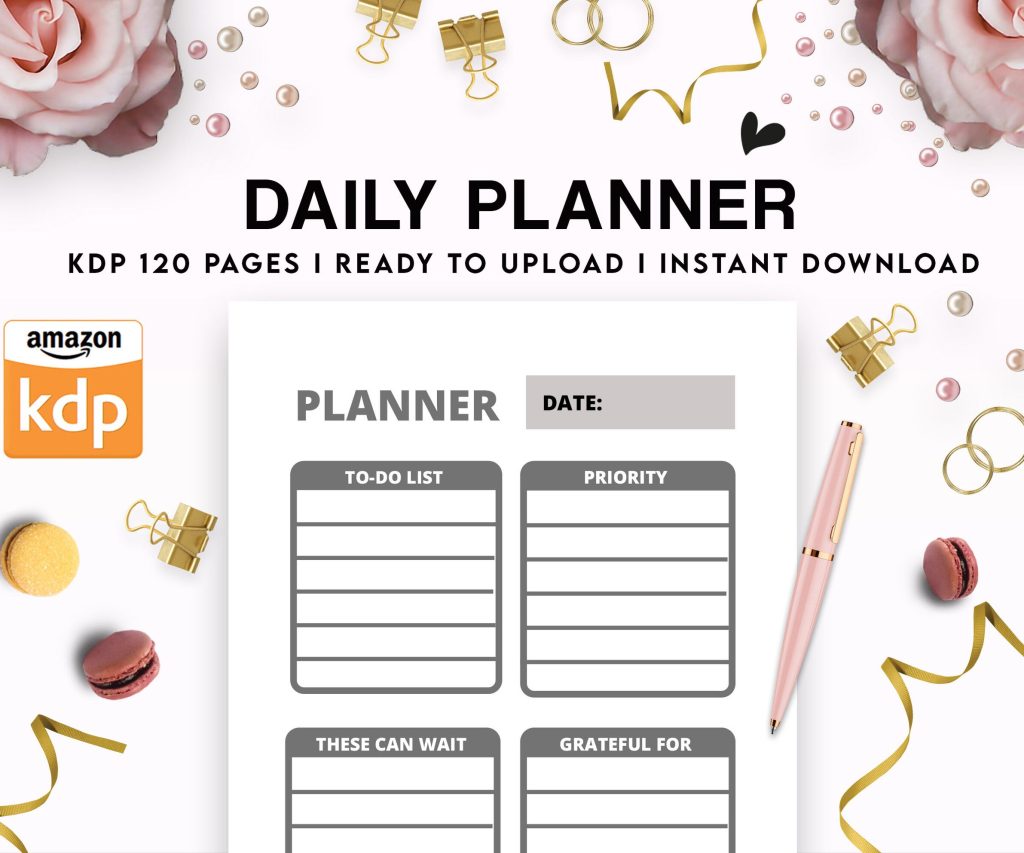 Daily Planner Diary : Diary Planners for Everyday Productivity, 120 pages, 6×9 Size | Amazon KDP Interior
1 × $0.00
Daily Planner Diary : Diary Planners for Everyday Productivity, 120 pages, 6×9 Size | Amazon KDP Interior
1 × $0.00 
DISCOVER OUR FREE BEST SELLING PRODUCTS
Editable Canva Lined Journal: Express Your Thoughts – KDP Template
Lined Pages Journal 120 pages Ready to Upload PDF Commercial Use KDP Template 6×9 8.5×11 5×8 for Notebooks, Diaries, Low Content
Lined Pages Journal 120 pages Ready to Upload PDF Commercial Use KDP Template 6×9 8.5×11 5×8 for Notebooks, Diaries, Low Content
Cute Dogs Coloring Book for Kids | Activity Book | KDP Ready-To-Upload
Daily Planner Diary : Diary Planners for Everyday Productivity, 120 pages, 6×9 Size | Amazon KDP Interior
Wolf Coloring KDP interior For Adults, Used as Low Content Book, PDF Template Ready To Upload COMMERCIAL Use 8.5×11"
Coloring Animals Head Book for Kids, Perfect for ages 2-4, 4-8 | 8.5×11 PDF
Printable Blank Comic Book Pages PDF : Create Your Own Comics – 3 Available Sizes
Notes KDP interior Ready To Upload, Sizes 8.5×11 6×9 5×8 inch PDF FILE Used as Amazon KDP Paperback Low Content Book, journal, Notebook, Planner, COMMERCIAL Use
Black Lined Journal: 120 Pages of Black Lined Paper Perfect for Journaling, KDP Notebook Template – 6×9
Student Planner Journal 120 pages Ready to Upload PDF Commercial Use KDP Template 6×9" 8.5×11" for Low Content book
Recipe Journal Template – Editable Recipe Book Template, 120 Pages – Amazon KDP Interior