
-
×
 Lined Pages Journal 120 pages Ready to Upload PDF Commercial Use KDP Template 6x9 8.5x11 5x8 for Notebooks, Diaries, Low Content
1 × $0.00
Lined Pages Journal 120 pages Ready to Upload PDF Commercial Use KDP Template 6x9 8.5x11 5x8 for Notebooks, Diaries, Low Content
1 × $0.00
Subtotal: $0.00
Okay so manga script format is way different than what most people think when they’re coming from like novel writing or even Western comic scripts, and I spent probably three months figuring this out the hard way when I was trying to format a guide for KDP last year.
The main thing you gotta understand is that manga scripts are super minimalist compared to American comic scripts. Like, if you’ve seen a Marvel or DC script, those things are NOVELS. They describe every panel in excruciating detail, camera angles, facial expressions, the whole deal. Manga scripts? They’re basically just the story beats and dialogue with some basic panel descriptions.
Most manga scripts in Japan follow what’s called the “name” format first, which is like a rough storyboard sketch with dialogue, but if you’re writing it out as an actual script document, here’s what you need:
Page Number – Always mark which page you’re on. Manga is super precise about page counts because of how magazines publish them.
Panel Number – Number each panel on the page. Most manga pages have between 4-7 panels but this varies wildly depending on pacing.
Panel Description – Keep this SHORT. Like one or two sentences max. “Kenji stands in the doorway, shocked” not “Kenji’s eyes widen as he processes the devastating scene before him, his hand trembling on the doorframe.”
Dialogue – Character name, then their line. That’s it.
Sound Effects – If you want specific SFX, note them. Japanese manga uses a TON of sound effects.
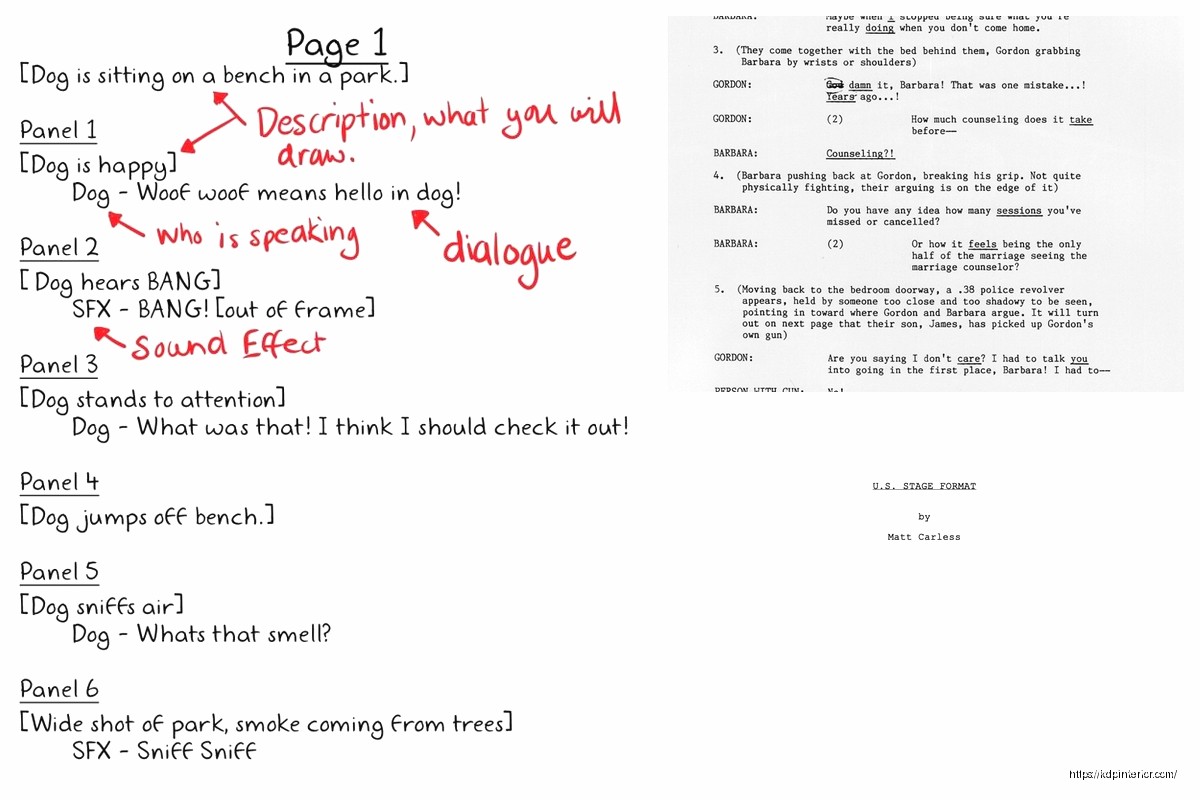
Here’s what a typical page looks like in script form:
PAGE 7
Panel 1: Wide shot of the school rooftop. Akira sits alone eating lunch.
AKIRA: Finally some peace and quiet…
Panel 2: Close-up of Akira’s surprised face looking up.
SFX: BANG (door slamming open)
Panel 3: Yuki bursts through the door, out of breath.
YUKI: There you are!
YUKI: We need to talk about yesterday!Panel 4: Akira stands up, annoyed.
AKIRA: Can’t this wait until—
See how bare-bones that is? And that’s actually MORE detailed than some professional manga writers use because they’re usually drawing their own work or working with an artist they’ve collaborated with for years.
Manga chapters are usually in multiples of 8 pages because of how printing works. Most serialized manga chapters are 16, 24, or 32 pages. One-shots might be 48 or 64 pages. You need to plan your script around these page counts from the start, not just write and see where it ends up.
I learned this the hard way when I was consulting with a client who wrote a 37-page manga script and then couldn’t figure out why no artist wanted to work with it. You either gotta cut 5 pages or add 11, and both options meant restructuring the entire story.
If you’re writing for traditional Japanese-style manga, remember readers go right to left, top to bottom. Your panel flow needs to account for this. Panel 1 is top RIGHT of the page, not top left. Most Western readers don’t even think about this until they see the actual pages laid out and everything feels backwards.
Though honestly if you’re publishing on Amazon KDP or Webtoon or whatever, you might be doing left-to-right anyway because that’s what English readers expect… but then is it really manga or just manga-influenced comics? That’s a whole different debate I’m not getting into right now.
One thing that tripped me up forever – manga dialogue is usually way more compact than Western comics. Speech bubbles in manga are smaller and there’s less room. Your character can’t give a whole philosophical monologue in one bubble.
Break up longer thoughts across multiple panels. Like instead of:
KENJI: I’ve been thinking about what you said yesterday and I realized that you were right about everything and I need to change.
You’d do:
Panel 1:
KENJI: I’ve been thinking…
Panel 2:
KENJI: About what you said yesterday.
Panel 3:
KENJI: You were right.
See how that creates pacing? Each panel is a beat, a pause, a moment for the art to do some heavy lifting. Western comics often put all that in one panel with a big text block. Manga spreads it out.
You need to differentiate these clearly in your script. I usually use:
KENJI: (for spoken dialogue)
KENJI (THINKS): (for internal monologue)
Some people use italics, some use parentheses, whatever works as long as you’re consistent. My cat just knocked over my coffee while I’m writing this, great timing Luna.
Action in manga scripts is probably the hardest thing to write because so much of it is visual. You can’t script every punch and kick – that’s micromanaging the artist and also impossible to read.
Instead, focus on:
Like:
Panel 1: Takeshi charges forward, fist raised.
Panel 2-4: [Action sequence – Takeshi and the monster exchange blows]
Panel 5: Takeshi lands a solid hit. The monster staggers back.
That “[Action sequence]” note gives the artist freedom to choreograph panels 2-4 however they want. Some writers hate this approach because they want total control, but manga is collaborative and artists need room to do their thing.
Every page turn in manga should have SOME kind of pull to keep reading. Not every page needs a massive cliffhanger, but there should be a question or tension or something interesting happening.
The right-side page (in traditional manga) is where you put your big reveals because that’s what the reader sees when they turn the page. The left side is where you set up the next moment.
I was watching Demon Slayer the other night and paying attention to how the manga handles this – every double-page spread has the “answer” or “impact” on the right page. It’s super deliberate.
Japanese manga uses sound effects as a design element, not just text. They’re integrated into the art, they’re stylized, they’re EVERYWHERE.
In your script, you don’t need to write them in Japanese unless you know Japanese. Just note what sound you want:
SFX: Footsteps
SFX: Door creaking
SFX: Explosion
SFX: Sword slash
The artist (or letterer) will handle making it look cool. But DO include them because they’re part of the pacing and atmosphere.
One thing though – don’t overdo it. Not every single action needs a sound effect. Use them for emphasis and atmosphere.
Manga does these differently than Western comics too. Often there’s no establishing shot or caption saying “LATER, AT THE MALL” or whatever. The scene just… changes.
You transition through visual cues. A panel of the sky. A panel of a clock. A panel of someone’s feet walking. Then you’re in the new scene.
In your script, you can note:
[SCENE TRANSITION – Exterior school building]Or just start the new scene and trust the artist to figure out the transition. This varies based on how much creative control you want vs how much you trust your collaborator.
Mark these clearly. I usually use:
[FLASHBACK START] (your panels)Or:
Panel 1: (FLASHBACK) Young Kenji stands in the rain…
Make it super obvious because the artist needs to style these differently – different screen tones, maybe softer lines, whatever visual language they use.
Okay so here’s some random things I wish someone had told me:
Narration boxes are way less common in manga than American comics. If you’re using them, use them sparingly. Most manga tells the story through dialogue and art, not narrator text.
Emotional reactions get their own panels sometimes. Like a character’s shocked face might be an entire panel with no dialogue. Note these in your script. “Panel 3: Close-up of Yuki’s devastated expression” – that’s a whole panel doing emotional work.
Background characters – mention if there are crowds or other people around, but don’t describe every single person. “Busy street with pedestrians” is enough.
Costume details – describe what characters wear once, maybe twice. Don’t repeat it every single time they appear. The artist will maintain visual consistency.
Some manga writers use screenplay format. Some use a simple numbered list. Some literally just sketch thumbnails with dialogue notes and call that their script.
The “correct” format is whatever works for you and your artist. If you’re submitting to a Japanese publisher, they might have specific requirements – check their submission guidelines.
For self-publishing on platforms like Amazon KDP (which is where most of my clients end up), you have total freedom. Just be clear and consistent.
Over-describing – You’re not writing a novel. “Kenji’s cerulean eyes glimmered with unshed tears” is way too much. “Kenji tears up” is enough.
Writing for the wrong page count – Already mentioned this but seriously, plan your page count from the start.
Ignoring panel flow – Readers’ eyes follow a specific path. Don’t fight against it.
Too much dialogue – If you’re writing paragraphs of dialogue, you’re doing it wrong. Manga is a visual medium first.
Not leaving room for art – Some pages should have minimal or even NO dialogue. Let the art tell the story sometimes.
I made all these mistakes when I first started helping clients format their manga scripts for print. Had one project where the writer wanted every single panel described in detail like a novel, and it was a nightmare to work with because no artist wants to be told exactly how to draw everything.
You don’t need special software honestly. Microsoft Word works fine. Google Docs works. I use Scrivener for longer projects because I can organize chapters easily, but it’s not necessary.
Some people use Celtx or Final Draft if they’re coming from screenwriting. That works too. The format matters more than the tool.
There’s software specifically for manga creation like Clip Studio Paint, but that’s more for artists. As a writer, you’re just creating a text document with clear formatting.
Whatever you use, just make sure you can easily share it with your artist. PDFs work great because formatting stays consistent across devices.
Anyway that’s basically the core of manga script format – keep it simple, trust your artist, think visually, and respect those page counts. Once you get the hang of it, it’s actually way faster to write than detailed American comic scripts because you’re not describing every little thing.
DISCOVER OUR FREE BEST SELLING PRODUCTS
Editable Canva Lined Journal: Express Your Thoughts – KDP Template
Lined Pages Journal 120 pages Ready to Upload PDF Commercial Use KDP Template 6×9 8.5×11 5×8 for Notebooks, Diaries, Low Content
Lined Pages Journal 120 pages Ready to Upload PDF Commercial Use KDP Template 6×9 8.5×11 5×8 for Notebooks, Diaries, Low Content
Cute Dogs Coloring Book for Kids | Activity Book | KDP Ready-To-Upload
Daily Planner Diary : Diary Planners for Everyday Productivity, 120 pages, 6×9 Size | Amazon KDP Interior
Wolf Coloring KDP interior For Adults, Used as Low Content Book, PDF Template Ready To Upload COMMERCIAL Use 8.5×11"
Coloring Animals Head Book for Kids, Perfect for ages 2-4, 4-8 | 8.5×11 PDF
Printable Blank Comic Book Pages PDF : Create Your Own Comics – 3 Available Sizes
Notes KDP interior Ready To Upload, Sizes 8.5×11 6×9 5×8 inch PDF FILE Used as Amazon KDP Paperback Low Content Book, journal, Notebook, Planner, COMMERCIAL Use
Black Lined Journal: 120 Pages of Black Lined Paper Perfect for Journaling, KDP Notebook Template – 6×9
Student Planner Journal 120 pages Ready to Upload PDF Commercial Use KDP Template 6×9" 8.5×11" for Low Content book
Recipe Journal Template – Editable Recipe Book Template, 120 Pages – Amazon KDP Interior